When to Use
The Split-Plot Design is used when:
- You have two treatment factors, but one is harder (or more expensive) to change than the other.
- The whole-plot factor is applied to larger units, and the sub-plot factor is applied within those units.
- Randomisation is restricted: the whole-plot factor is randomised first, then the sub-plot factor is randomised within each whole plot.
Common examples: irrigation method (whole-plot) x fertilizer type (sub-plot), or tillage system (whole-plot) x crop variety (sub-plot).
The Design
The split-plot design has two error terms:
where:
- = replicate (block) effect
- = whole-plot treatment effect
- = whole-plot error
- = sub-plot treatment effect
- = interaction
- = sub-plot error
This requires a mixed model because the whole-plot error is a random effect.
Data
We use a dataset with 6 whole-plot treatments, 3 sub-plot treatments, and 6 replicates.
library(agrideshr)
data(split_plot_data)
str(split_plot_data)
#> Classes 'tbl_df', 'tbl' and 'data.frame':    108 obs. of  4 variables:
#>  $ Replicate: Factor w/ 6 levels "X1","X2","X3",..: 1 2 3 4 5 6 1 2 3 4 ...
#>  $ WholePlot: Factor w/ 6 levels "1","2","3","4",..: 1 1 1 1 1 1 1 1 1 1 ...
#>  $ SubPlot  : Factor w/ 3 levels "d1","d2","d3": 1 1 1 1 1 1 2 2 2 2 ...
#>  $ Yield    : num  58.6 64.8 63.2 58.5 60.1 63.4 54.6 53.8 54.4 57.6 ...
head(split_plot_data, 12)
#>    Replicate WholePlot SubPlot Yield
#> 1         X1         1      d1  58.6
#> 2         X2         1      d1  64.8
#> 3         X3         1      d1  63.2
#> 4         X4         1      d1  58.5
#> 5         X5         1      d1  60.1
#> 6         X6         1      d1  63.4
#> 7         X1         1      d2  54.6
#> 8         X2         1      d2  53.8
#> 9         X3         1      d2  54.4
#> 10        X4         1      d2  57.6
#> 11        X5         1      d2  63.6
#> 12        X6         1      d2  58.5
Exploratory Visualization
library(ggplot2)

ggplot(split_plot_data, aes(x = WholePlot, y = Yield, colour = SubPlot,
                             group = SubPlot)) +
  geom_line() +
  facet_wrap(~ Replicate) +
  theme_bw() +
  labs(title = "Yield by Whole-Plot and Sub-Plot Treatment (by Replicate)")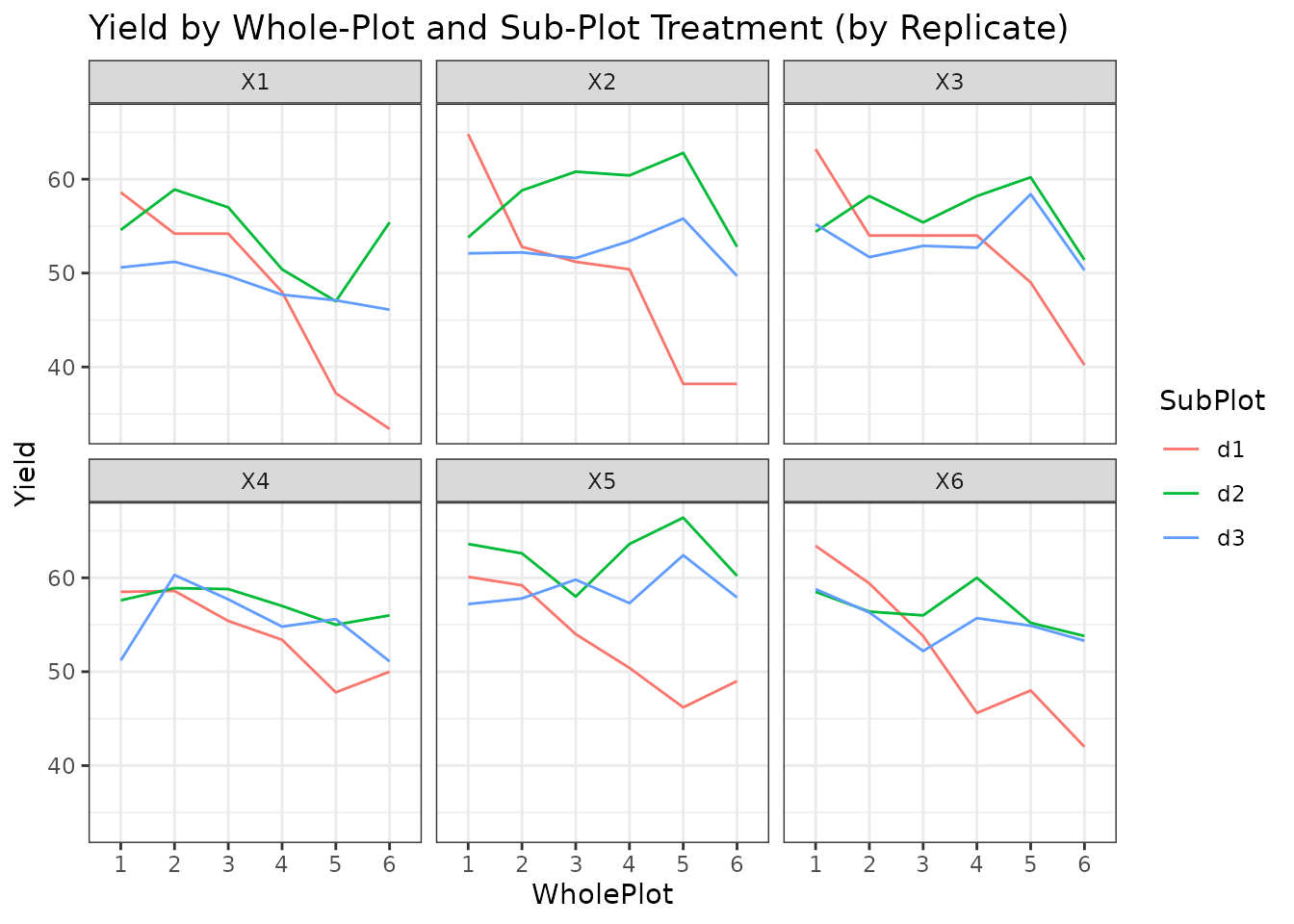
ggplot(split_plot_data, aes(x = WholePlot, y = Yield, fill = SubPlot)) +
  geom_boxplot(alpha = 0.7) +
  theme_bw() +
  labs(title = "Yield by Whole-Plot and Sub-Plot Treatment")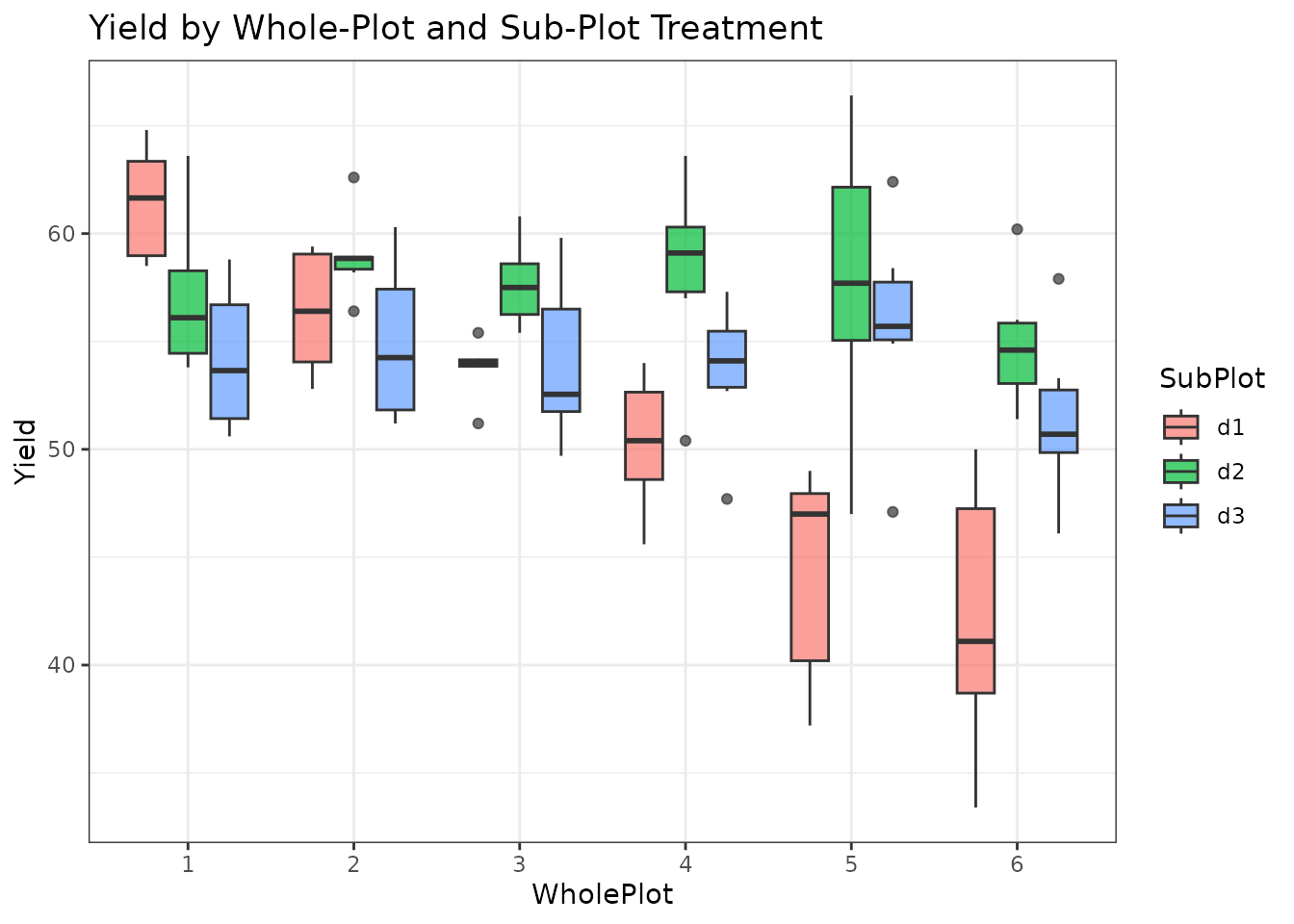
Model Fitting
Unlike the previous designs, split-plot requires a linear
mixed model using lmer() from the
lmerTest package. The term
(1 | Replicate:WholePlot) captures the whole-plot
error:
library(lmerTest)

fit <- lmer(Yield ~ Replicate + WholePlot * SubPlot + (1 | Replicate:WholePlot),
            data = split_plot_data)
ANOVA Table
anova(fit)
#> Type III Analysis of Variance Table with Satterthwaite's method
#>                   Sum Sq Mean Sq NumDF DenDF F value    Pr(>F)
#> Replicate         423.44   84.69     5    25  10.019 2.359e-05 ***
#> WholePlot         530.26  106.05     5    25  12.547 3.705e-06 ***
#> SubPlot           663.31  331.66     2    60  39.238 1.269e-11 ***
#> WholePlot:SubPlot 942.58   94.26    10    60  11.152 1.839e-10 ***
#> ---
#> Signif. codes:  0 '***' 0.001 '**' 0.01 '*' 0.05 '.' 0.1 ' ' 1
The F-tests use appropriate denominator degrees of freedom:
- WholePlot is tested against the whole-plot error.
- SubPlot and WholePlot:SubPlot are tested against the sub-plot (residual) error.
Variance Components
VarCorr(fit)
#>  Groups              Name        Std.Dev.
#>  Replicate:WholePlot (Intercept) 1.1544
#>  Residual                        2.9073
Assumption Checking
For mixed models, we check residuals at the sub-plot level:
resid_vals <- residuals(fit)
fitted_vals <- fitted(fit)

par(mfrow = c(1, 2), mar = c(4, 4, 3, 1))
plot(fitted_vals, resid_vals,
     xlab = "Fitted", ylab = "Residuals",
     main = "Residuals vs Fitted", pch = 16, col = "steelblue")
abline(h = 0, lty = 2, col = "red")

qqnorm(resid_vals, main = "Normal Q-Q Plot", pch = 16, col = "steelblue")
qqline(resid_vals, col = "red", lwd = 2)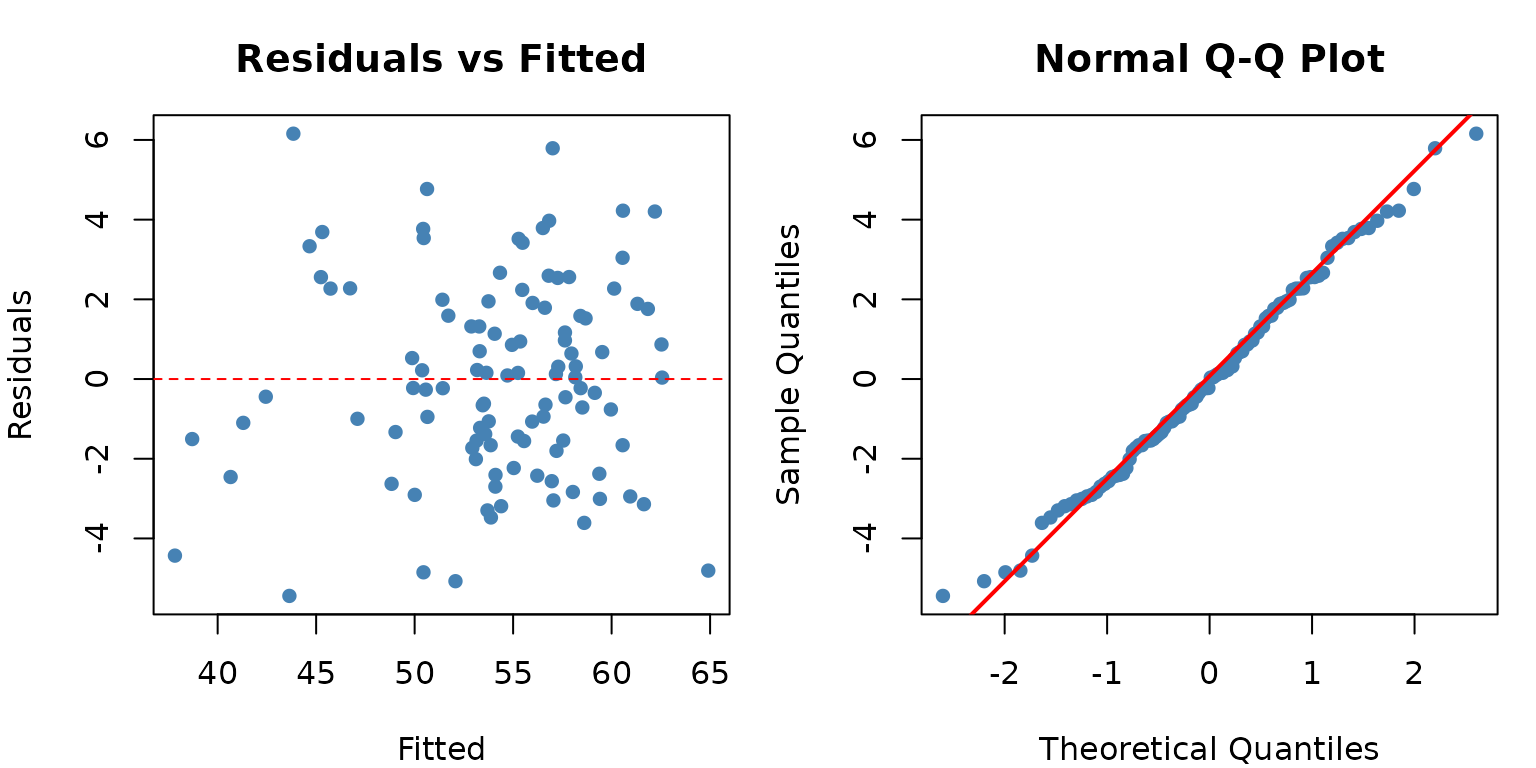
shapiro.test(resid_vals)
#>
#>  Shapiro-Wilk normality test
#>
#> data:  resid_vals
#> W = 0.99214, p-value = 0.7939
Post-hoc Comparisons
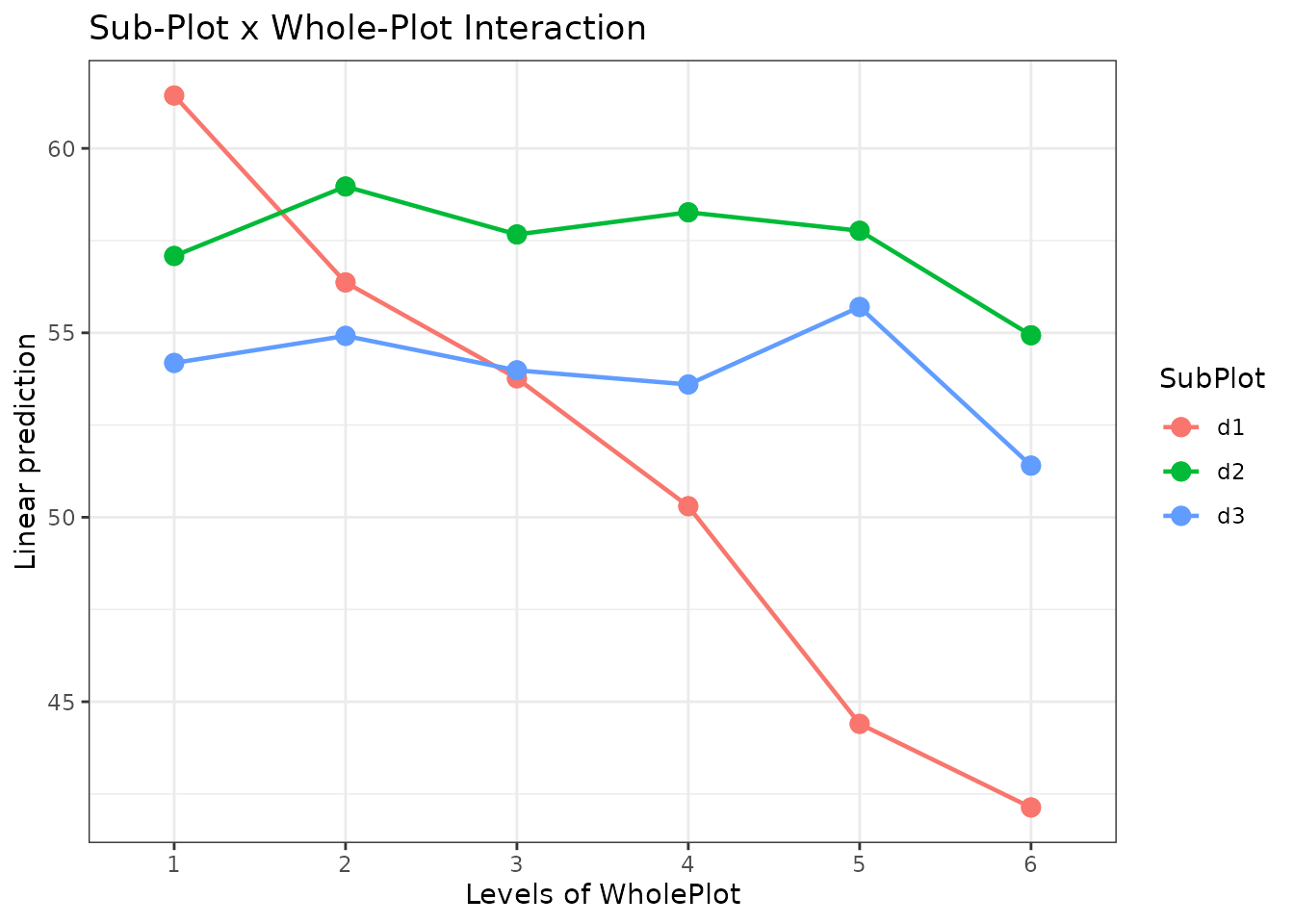
Estimated Marginal Means
Whole-plot treatment within each sub-plot level
library(emmeans)

emm_a <- emmeans(fit, ~ WholePlot | SubPlot)
pairs(emm_a)
#> SubPlot = d1:
#>  contrast                estimate   SE   df t.ratio p.value
#>  WholePlot1 - WholePlot2    5.067 1.81 78.6   2.805  0.0671
#>  WholePlot1 - WholePlot3    7.667 1.81 78.6   4.245  0.0008
#>  WholePlot1 - WholePlot4   11.133 1.81 78.6   6.165 <0.0001
#>  WholePlot1 - WholePlot5   17.033 1.81 78.6   9.431 <0.0001
#>  WholePlot1 - WholePlot6   19.300 1.81 78.6  10.686 <0.0001
#>  WholePlot2 - WholePlot3    2.600 1.81 78.6   1.440  0.7029
#>  WholePlot2 - WholePlot4    6.067 1.81 78.6   3.359  0.0148
#>  WholePlot2 - WholePlot5   11.967 1.81 78.6   6.626 <0.0001
#>  WholePlot2 - WholePlot6   14.233 1.81 78.6   7.881 <0.0001
#>  WholePlot3 - WholePlot4    3.467 1.81 78.6   1.920  0.3982
#>  WholePlot3 - WholePlot5    9.367 1.81 78.6   5.186 <0.0001
#>  WholePlot3 - WholePlot6   11.633 1.81 78.6   6.441 <0.0001
#>  WholePlot4 - WholePlot5    5.900 1.81 78.6   3.267  0.0194
#>  WholePlot4 - WholePlot6    8.167 1.81 78.6   4.522  0.0003
#>  WholePlot5 - WholePlot6    2.267 1.81 78.6   1.255  0.8081
#>
#> SubPlot = d2:
#>  contrast                estimate   SE   df t.ratio p.value
#>  WholePlot1 - WholePlot2   -1.883 1.81 78.6  -1.043  0.9019
#>  WholePlot1 - WholePlot3   -0.583 1.81 78.6  -0.323  0.9995
#>  WholePlot1 - WholePlot4   -1.183 1.81 78.6  -0.655  0.9862
#>  WholePlot1 - WholePlot5   -0.683 1.81 78.6  -0.378  0.9990
#>  WholePlot1 - WholePlot6    2.150 1.81 78.6   1.190  0.8401
#>  WholePlot2 - WholePlot3    1.300 1.81 78.6   0.720  0.9790
#>  WholePlot2 - WholePlot4    0.700 1.81 78.6   0.388  0.9988
#>  WholePlot2 - WholePlot5    1.200 1.81 78.6   0.664  0.9853
#>  WholePlot2 - WholePlot6    4.033 1.81 78.6   2.233  0.2346
#>  WholePlot3 - WholePlot4   -0.600 1.81 78.6  -0.332  0.9994
#>  WholePlot3 - WholePlot5   -0.100 1.81 78.6  -0.055  1.0000
#>  WholePlot3 - WholePlot6    2.733 1.81 78.6   1.513  0.6567
#>  WholePlot4 - WholePlot5    0.500 1.81 78.6   0.277  0.9998
#>  WholePlot4 - WholePlot6    3.333 1.81 78.6   1.846  0.4431
#>  WholePlot5 - WholePlot6    2.833 1.81 78.6   1.569  0.6212
#>
#> SubPlot = d3:
#>  contrast                estimate   SE   df t.ratio p.value
#>  WholePlot1 - WholePlot2   -0.733 1.81 78.6  -0.406  0.9985
#>  WholePlot1 - WholePlot3    0.200 1.81 78.6   0.111  1.0000
#>  WholePlot1 - WholePlot4    0.583 1.81 78.6   0.323  0.9995
#>  WholePlot1 - WholePlot5   -1.517 1.81 78.6  -0.840  0.9591
#>  WholePlot1 - WholePlot6    2.783 1.81 78.6   1.541  0.6391
#>  WholePlot2 - WholePlot3    0.933 1.81 78.6   0.517  0.9954
#>  WholePlot2 - WholePlot4    1.317 1.81 78.6   0.729  0.9778
#>  WholePlot2 - WholePlot5   -0.783 1.81 78.6  -0.434  0.9980
#>  WholePlot2 - WholePlot6    3.517 1.81 78.6   1.947  0.3819
#>  WholePlot3 - WholePlot4    0.383 1.81 78.6   0.212  0.9999
#>  WholePlot3 - WholePlot5   -1.717 1.81 78.6  -0.951  0.9318
#>  WholePlot3 - WholePlot6    2.583 1.81 78.6   1.430  0.7085
#>  WholePlot4 - WholePlot5   -2.100 1.81 78.6  -1.163  0.8530
#>  WholePlot4 - WholePlot6    2.200 1.81 78.6   1.218  0.8267
#>  WholePlot5 - WholePlot6    4.300 1.81 78.6   2.381  0.1757
#>
#> Results are averaged over the levels of: Replicate
#> Degrees-of-freedom method: kenward-roger
#> P value adjustment: tukey method for comparing a family of 6 estimates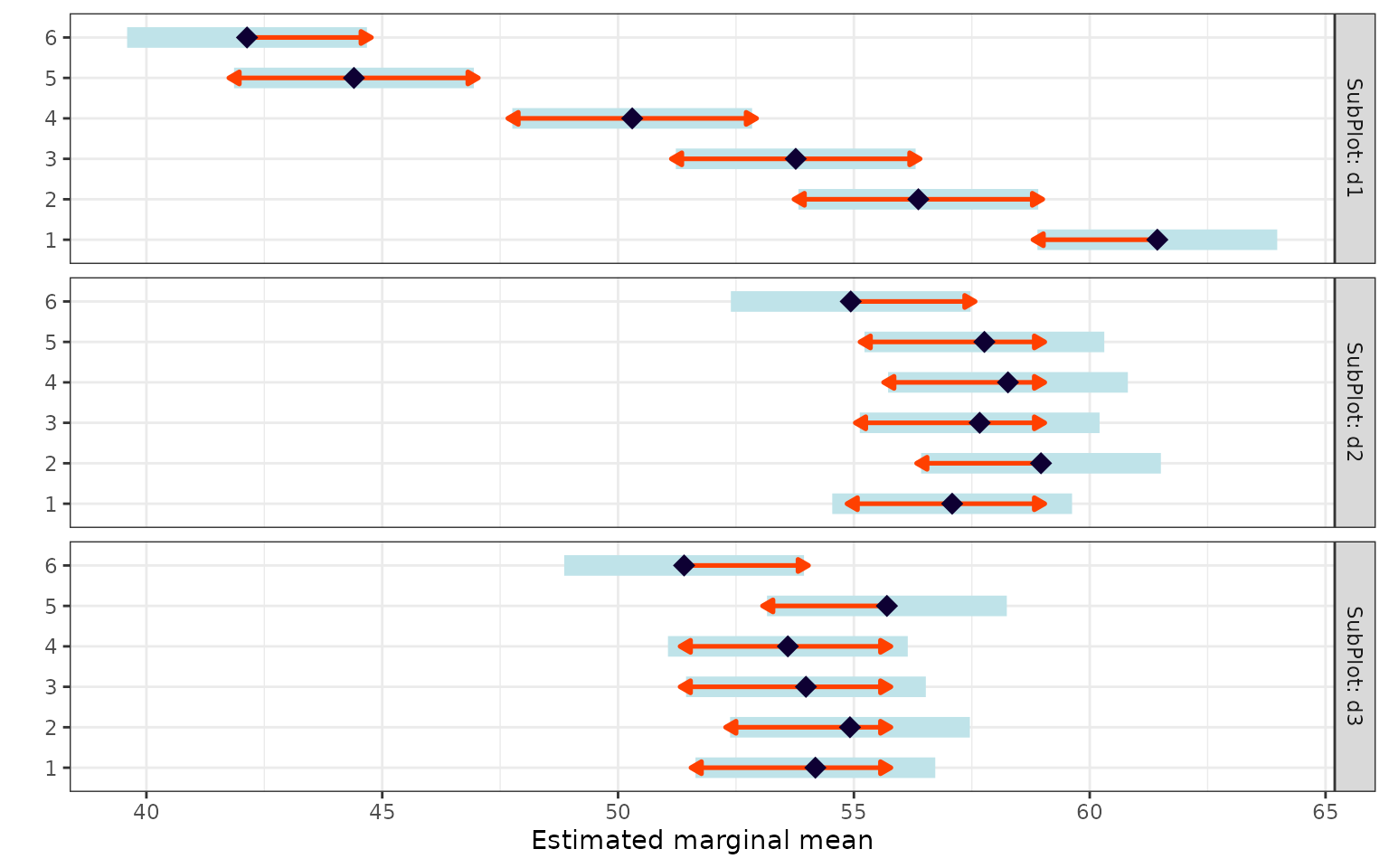
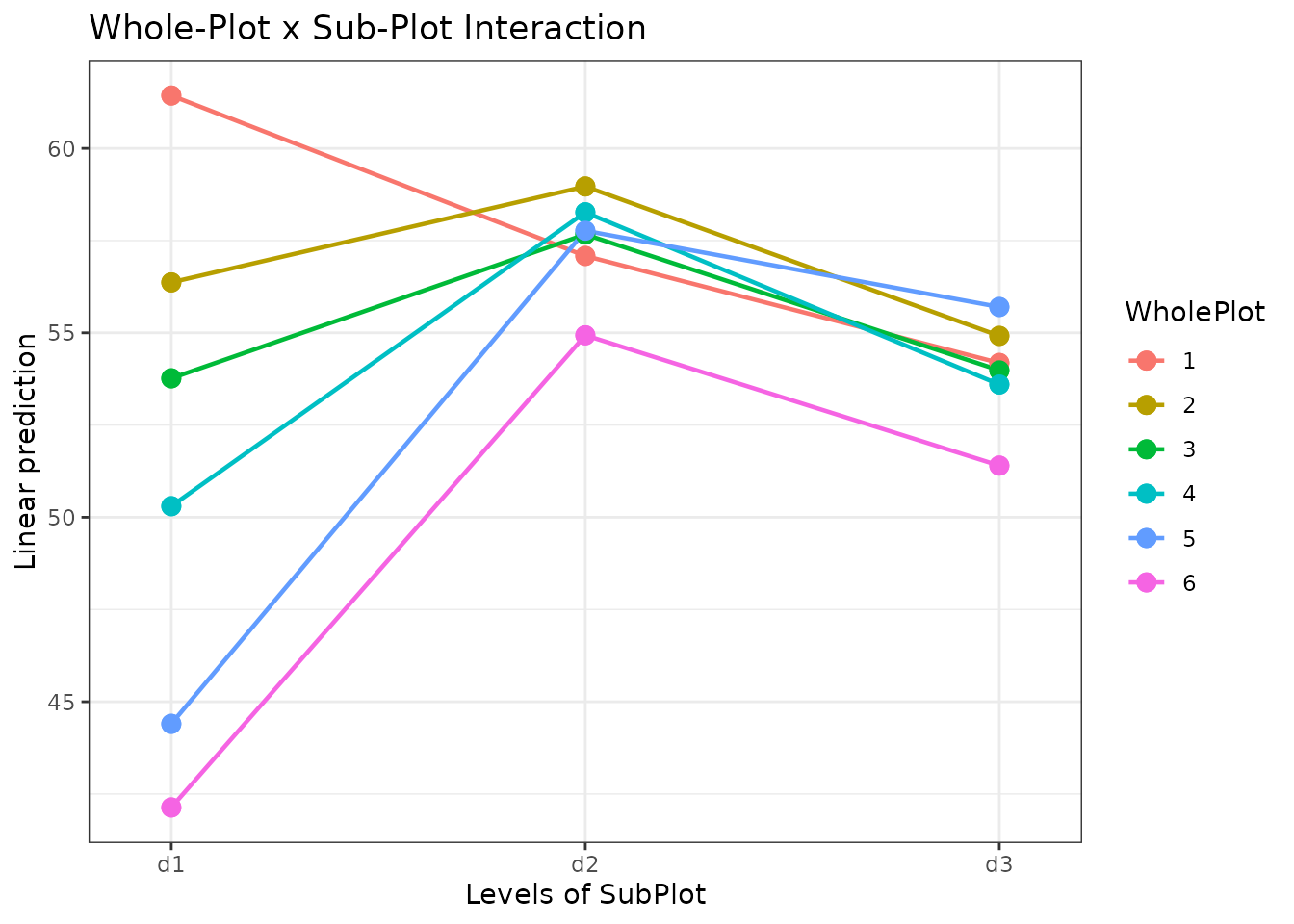
Sub-plot treatment within each whole-plot level
emm_b <- emmeans(fit, ~ SubPlot | WholePlot)
pairs(emm_b)
#> WholePlot = 1:
#>  contrast estimate   SE df t.ratio p.value
#>  d1 - d2     4.350 1.68 60   2.592  0.0317
#>  d1 - d3     7.250 1.68 60   4.319  0.0002
#>  d2 - d3     2.900 1.68 60   1.728  0.2033
#>
#> WholePlot = 2:
#>  contrast estimate   SE df t.ratio p.value
#>  d1 - d2    -2.600 1.68 60  -1.549  0.2757
#>  d1 - d3     1.450 1.68 60   0.864  0.6650
#>  d2 - d3     4.050 1.68 60   2.413  0.0489
#>
#> WholePlot = 3:
#>  contrast estimate   SE df t.ratio p.value
#>  d1 - d2    -3.900 1.68 60  -2.323  0.0602
#>  d1 - d3    -0.217 1.68 60  -0.129  0.9909
#>  d2 - d3     3.683 1.68 60   2.194  0.0803
#>
#> WholePlot = 4:
#>  contrast estimate   SE df t.ratio p.value
#>  d1 - d2    -7.967 1.68 60  -4.746 <0.0001
#>  d1 - d3    -3.300 1.68 60  -1.966  0.1295
#>  d2 - d3     4.667 1.68 60   2.780  0.0196
#>
#> WholePlot = 5:
#>  contrast estimate   SE df t.ratio p.value
#>  d1 - d2   -13.367 1.68 60  -7.963 <0.0001
#>  d1 - d3   -11.300 1.68 60  -6.732 <0.0001
#>  d2 - d3     2.067 1.68 60   1.231  0.4396
#>
#> WholePlot = 6:
#>  contrast estimate   SE df t.ratio p.value
#>  d1 - d2   -12.800 1.68 60  -7.626 <0.0001
#>  d1 - d3    -9.267 1.68 60  -5.521 <0.0001
#>  d2 - d3     3.533 1.68 60   2.105  0.0973
#>
#> Results are averaged over the levels of: Replicate
#> Degrees-of-freedom method: kenward-roger
#> P value adjustment: tukey method for comparing a family of 3 estimates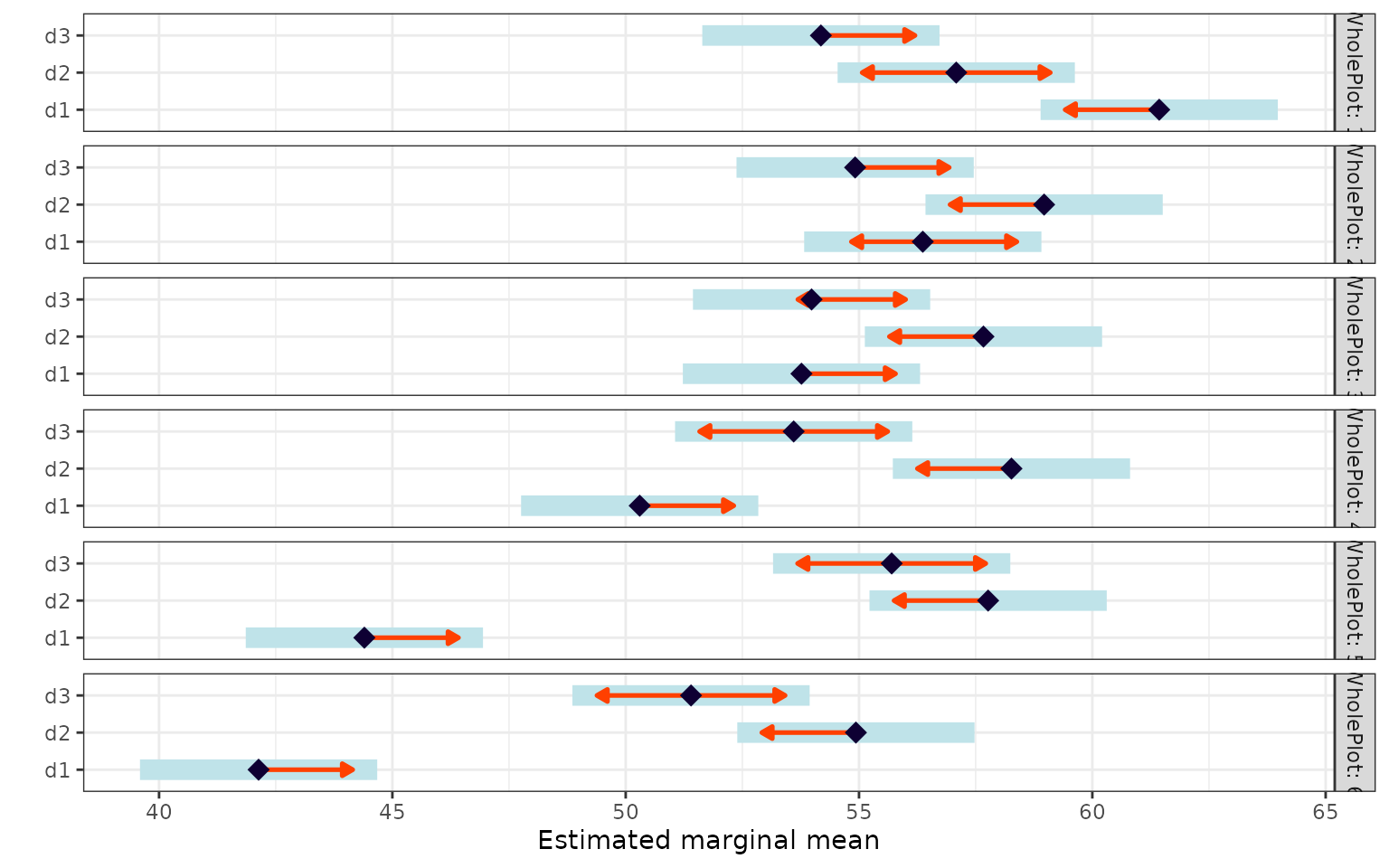
Conclusion
The split-plot design is essential when practical constraints prevent full randomisation of all treatment combinations. Key points:
-
Mixed model is required (
lmer, notaov) to correctly partition the two error terms. - The whole-plot factor is tested with less precision (fewer effective replicates) than the sub-plot factor.
-
emmeans with conditional contrasts
(
~ A | B) is the appropriate way to make pairwise comparisons.
Design Summary
| Design | Vignette | Factors | Blocking | Model |
|---|---|---|---|---|
| CRD | 01 | 1 | None | aov(Y ~ A) |
| RCBD | 02 | 1 + Block | 1 blocking factor | aov(Y ~ Block + A) |
| Latin Square | 03 | 1 + Row + Col | 2 blocking factors | aov(Y ~ Row + Col + A) |
| Factorial | 04 | 2+ crossed | Optional | aov(Y ~ A * B) |
| Split-Plot | 05 | 2 nested | Replicates | lmer(Y ~ A*B + (1|Rep:A)) |